Connecting VPCs: peering, TGW & hybrid
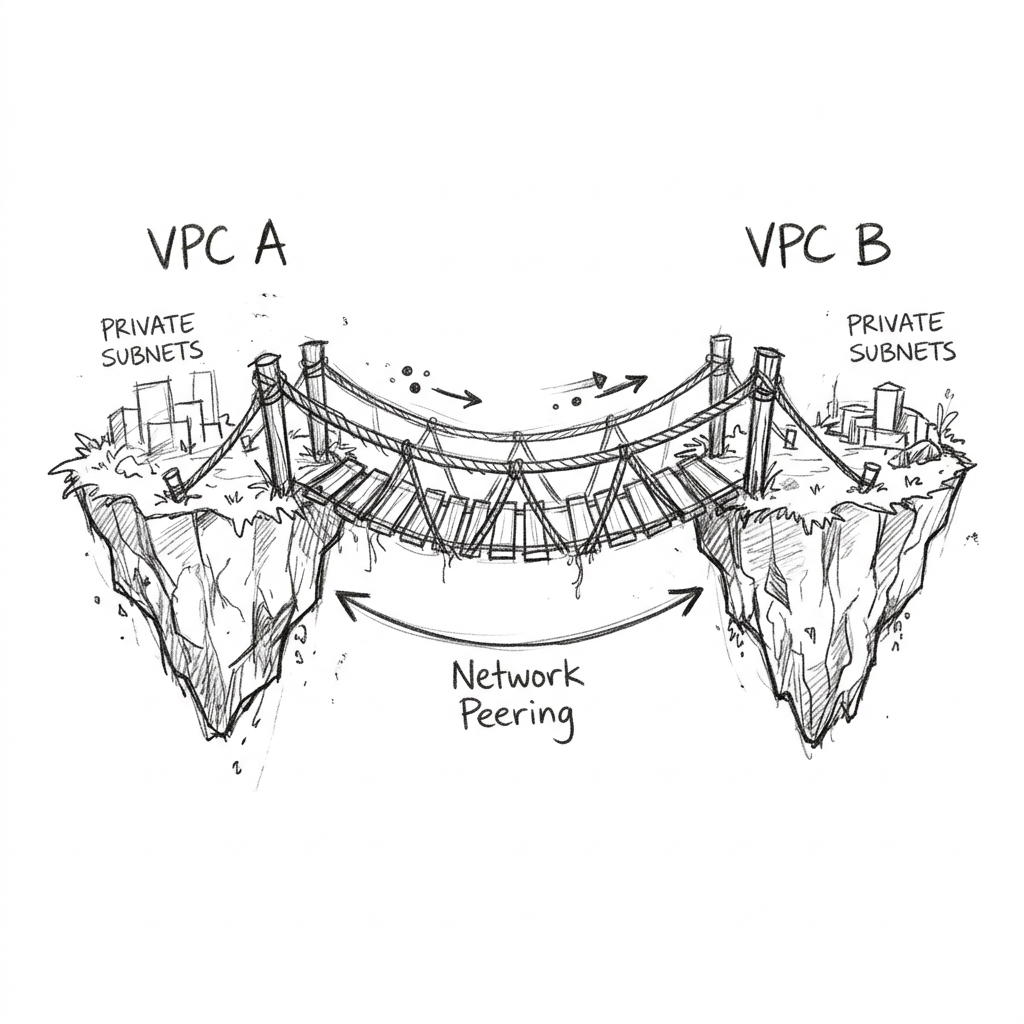
One VPC never stays alone. Teams get their own, environments get their own (prod/staging), acquisitions bring theirs, and eventually someone asks: "can service A in VPC-A call service B in VPC-B?" By default, absolutely not: VPCs are islands. This lesson is about the bridges.
VPC peering: a private cable between two VPCs
A peering connection joins exactly two VPCs so they can talk over private IPs: no internet, no gateways, no bandwidth bottleneck. But accepting the peering request is only step one. Nothing flows until both sides add routes. Feel that:
Peering routes: both sides or nothing
VPC-A and VPC-B are peered (pcx-11aa). Toggle the routes and send a request from A to B. A request needs a path there: and its reply needs a path back.
And the classic gotcha: peering CIDR overlap. Peering works by routing, and routing needs unambiguous destinations. If both VPCs are 10.0.0.0/16, a route "10.0.0.0/16 → peer" would fight the VPC's own local route. AWS simply refuses:
Try to peer twins
This is why organizations keep a CIDR allocation plan from day one: every new VPC gets a unique block (10.0/16, 10.1/16, 10.2/16…). Retro-fixing overlaps means re-IPing entire environments.
The transitivity wall: and the Transit Gateway
Peering has a hard rule: it is not transitive. If A peers with B, and B peers with C, then A still cannot reach C. Traffic will not hop through B, ever: the peering connection only forwards traffic between its own two members. With many VPCs, full connectivity via peering needs a mesh: 10 VPCs → 45 connections, each with routes on both sides. That's the n² problem, and the Transit Gateway (TGW) is the answer: a managed regional router every VPC attaches to once. Hub and spoke instead of mesh.
Watch transitivity fail, then fix it with a hub
A–B are peered; B–C are peered. Send A → C. Then flip to Transit Gateway mode and try again.
Reaching outside AWS: VPN and Direct Connect
Site-to-Site VPN
- Encrypted IPsec tunnels over the public internet
- Terminates on a Virtual Private Gateway or TGW
- Up and running in hours; cheap
- Latency and jitter are the internet's: no guarantees
- ~1.25 Gbps per tunnel ceiling
Direct Connect
- A physical fiber from your data center/colo into AWS
- Consistent latency, 1–100 Gbps
- Weeks to provision; real money
- Not encrypted by itself: often paired with VPN on top
- The choice when hybrid is a permanent architecture, not a bridge
Both typically land on the Transit Gateway in mature setups, making on-prem effectively "one more spoke" in the hub.