Consensus: replication that elects its own leader
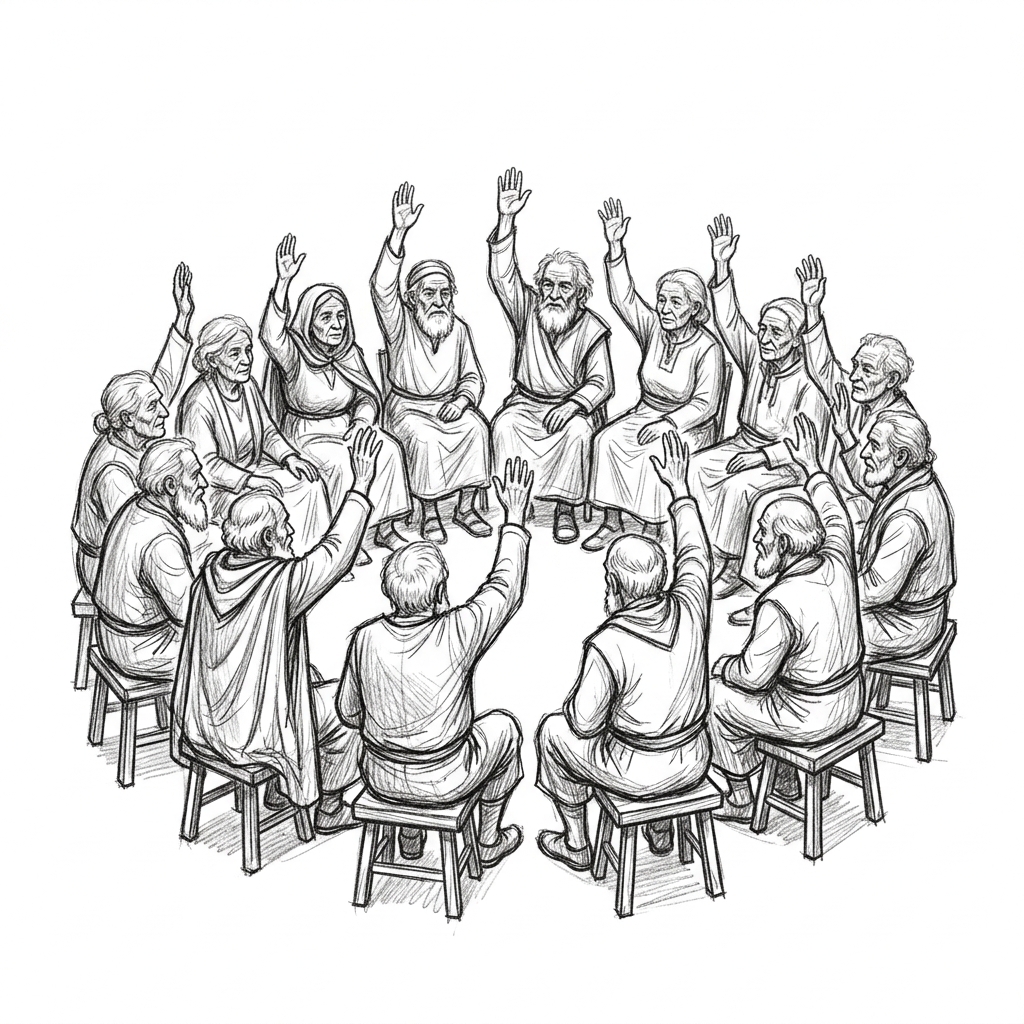
Lesson 1 ended with a horror story: a zombie leader, a skipped fencing step, split-brain. The root problem was that leadership was an assumption: configured by humans, revoked by hope. Consensus algorithms (Raft, Paxos, Zab) make leadership a provable fact: a node leads only if a majority of the cluster voted for it, and a write is committed only when a majority holds it. Majorities of the same cluster always intersect: so two simultaneous legitimate leaders are mathematically impossible.
This is the machinery inside etcd (which runs Kubernetes), CockroachDB, TiDB, MongoDB's replica-set elections, Kafka's KRaft, Consul, ZooKeeper, and the coordination layer of Aurora and Spanner. We'll use Raft, the one designed to be understandable. Two mechanisms, two labs: elections and log commitment.
Mechanism 1: elections with terms and votes
Every node is a follower, candidate, or leader. Time is divided into numbered terms. Followers expect heartbeats from the leader; when a follower's randomized election timeout expires with no heartbeat, it increments the term, becomes a candidate, and requests votes. Each node votes for at most one candidate per term. Majority of the full cluster (3 of 5) wins: and if no majority is reachable, nobody wins, on purpose.
Run the elections yourself
Five nodes, one leader. Click any node to crash/revive it. When the leader is dead, fire the election timeout and watch votes gather. Then get destructive: crash nodes until only two remain, and try to elect anyone.
Three details make this bulletproof. Randomized timeouts mean one node usually times out first and wins cleanly; ties just retry with new random timers. One vote per term means two candidates can't both reach a majority in the same term. And a candidate must have a log at least as up-to-date as each voter's: so a node missing committed entries can never win, which kills Lesson 1's "promoted the stale follower" data-loss bug by rule rather than by operator diligence.
Mechanism 2: majority commit: and why split-brain can't happen
The leader appends each write to its log and replicates it. The write is committed: acknowledged to the client, applied to the state machine: only once a majority of nodes hold it. Now the payoff. Walk through the exact scenario that destroyed Lesson 1's cluster:
The partition drill
Five nodes; n1 leads. A network partition splits {n1, n2} from {n3, n4, n5}. Step through what each side can and cannot do.
Where this sits among the four architectures
Consensus is single-leader replication with the two hard problems: who leads, and what survives: solved by protocol instead of by operators. You'd choose it when correctness is non-negotiable: metadata stores (etcd under Kubernetes, ZooKeeper under Kafka), financial ledgers, distributed SQL (CockroachDB runs one Raft group per data range: thousands of tiny consensus clusters). You'd avoid it where its costs bite: majority round-trips on every write, minimum three nodes, and cross-region deployments where "majority" means intercontinental latency on every commit.